
An interactive look at Article 6.8 of the Paris Agreement and its potential to bring about a transition to climate-smart trade, finance, and everyday economics, in all regions.
- Thursday, November 21, 2024
- 3:30 – 4:50 pm EST
- Virtual workshop
- Tobin College of Business, St. John’s University

Major structural anchors of Earth’s stable climate system—like Arctic ice—are disappearing; costs of dangerous climate impacts are piling up and getting worse.
Article 6.8 of the Paris Agreement invites multidimensional multilateral cooperation to accelerate climate action, reduce poverty, and drive sustainable development.
So, why are climate-smart industry, trade, and finance not the everyday reality, for everyone, everywhere?
Paris Agreement, Article 6, paragraph 8:
Parties recognize the importance of integrated, holistic and balanced non-market approaches being available to Parties to assist in the implementation of their nationally determined contributions, in the context of sustainable development and poverty eradication, in a coordinated and effective manner, including through, inter alia, mitigation, adaptation, finance, technology transfer and capacity-building, as appropriate. These approaches shall aim to:
(a) Promote mitigation and adaptation ambition;
(b) Enhance public and private sector participation in the implementation of nationally determined contributions; and
(c) Enable opportunities for coordination across instruments and relevant institutional arrangements.
Article 6.8 of the Paris Agreement points to international cooperation to accelerate climate action, without emissions trading. It effectively invites multilateral agreements that mainstream climate action across the whole economy—advancing climate-smart trade and finance.
The project of mainstreaming climate action is by its nature layered, cooperative, and involves scaling innovative business models across diverse economic conditions. It is also about ensuring more people have access to quality services and products that make their lives easier, improve affordability and clean development, and create opportunities for new local investment and job creation. Trade is a scaling mechanism, opening new productive capacity and new markets to expand the investability of innovative solutions.
The big question we all face, as the world moves toward trade and finance aligned with consistent creation of climate value, is how that new value creation lands in local experience. What do we experience in our communities? What new jobs and industries arise? Will intermediary services transform local and regional economic fortunes? How will we be safer? How will we leverage innovation to build lives that work for people in the circumstances they live day to day?
In this 90-minute workshop, CCI Executive Director Joe Robertson will take students through a series of practical and theoretical questions about the opporutnities for action embedded in Article 6.8. Participants will review existing and emerging Non-Market Approaches (see Longlist of NMAs) and discuss what is happening at the COP29 negotiations in Baku.
Small groups will explore action steps for mainstreaming in key areas of climate crisis response:
- Adaptation and resilience – moving to zero harm
- Energy and decarbonization
- Food systems, nature restoration and biodiversity recovery
- Shipping, logistics, and distribution
- Urban-rural cooperation
While the workshop is for students only, anyone is welcome to explore the detailed event page and background readings.
FEATURED IMAGE

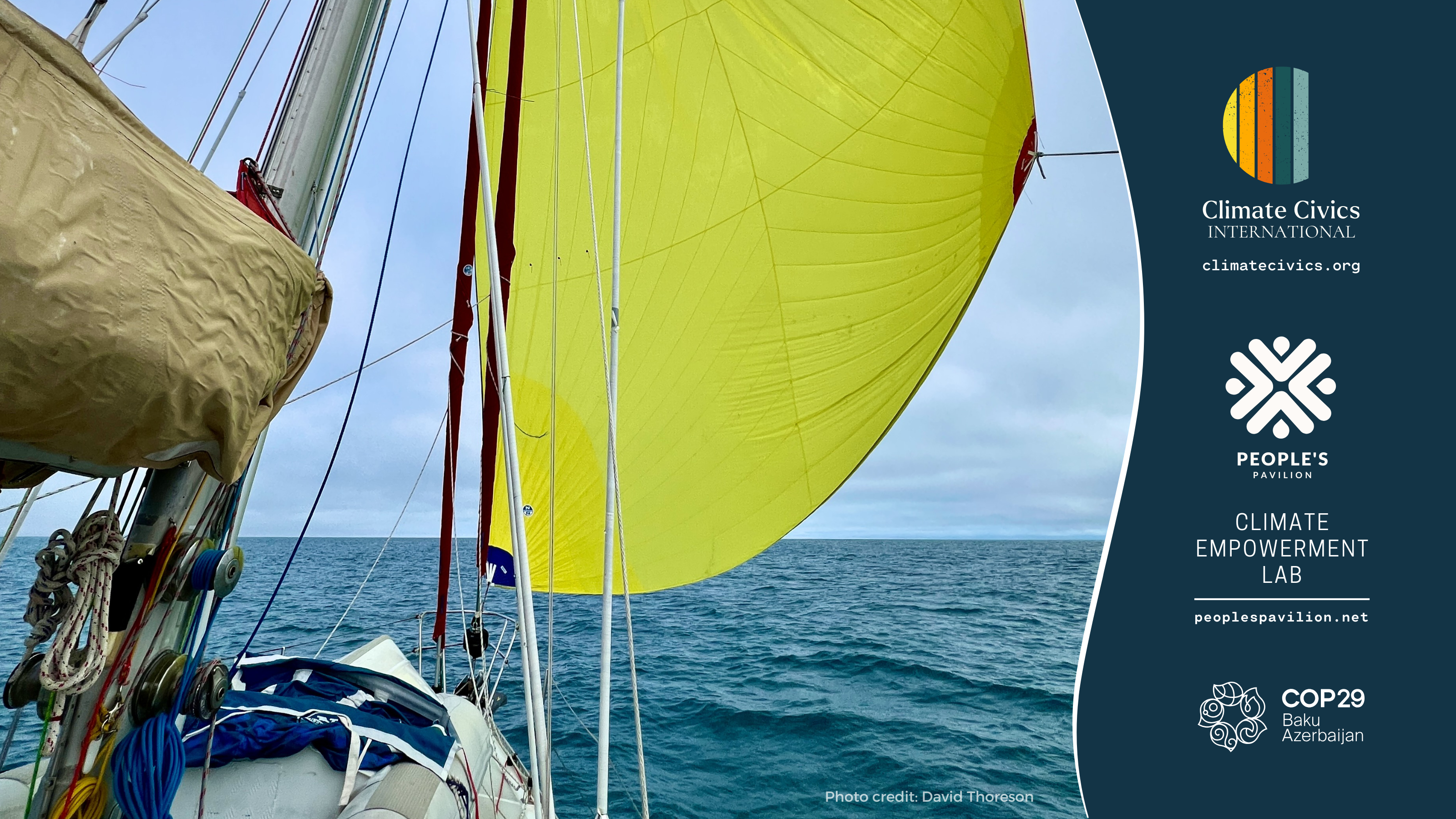
The featured image was shot by David Thoreson, a photographer, sailor, and Arctic explorer. David was the first American to navigate the Northwest Passage in both directions, first on the pioneering Cloud Nine voyage, and then with the Around the Americas voyage that provided ground-truthing research to NASA and education at 50 ports along the coastlines of North and South America.
David’s personal experience of entering into our currently ongoing Age of Climate Exploration—when we are no longer mapping our planet but getting to know its life-supporting systems and what it means to see them in good health or at risk—is recounted in an essay we co-authored that was published in the Guardian in 2016.
I highlight the ice-free Arctic in this workshop, because however remote our planet’s polar regions may seem, they are intimately connected to our everyday experience, through the climate system.
OUR COP29 COVERAGE


Something went wrong. Please refresh the page and/or try again.